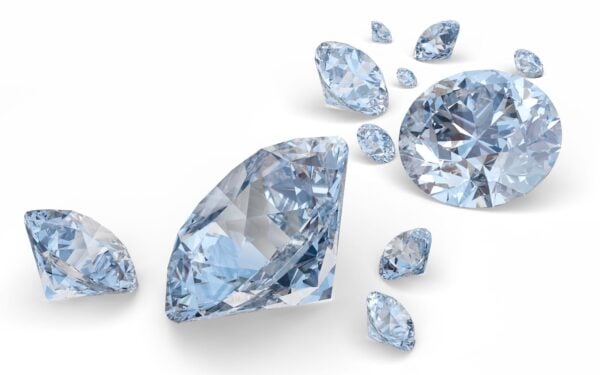
Place your mouse cursor over each diamond for a few seconds to highlight the flaws.
|
F (Flawless) : No inclusions (internal) or blemishes (external) visible to the trained eye using 10 power magnification corrected for spherical and chromatic aberration. |
IF (Internally Flawless) : No inclusions but they do possess minor surface blemishes that are visible to the trained eye using 10-power magnification. |
VVS 1 (Very Very Small Inclusions) : Minute inclusions; extremely difficult for the trained eye to observe at 10-power magnification. |
 |

Point to diamond for flaws |

Point to diamond for flaws |
VVS 2 (Very Very Small Inclusions) : Minute inclusions; very difficult for the trained eye to observe at 10-power magnification. |
VS 1 (Very Slightly Imperfect 1) : Minor inclusions; difficult for the untrained eye to observe inclusions at 10-power magnification. |
VS 2 (Very Slightly Imperfect 2) : Minor inclusions; somewhat difficult for the trained eye to observe at 10-power magnification. The difference between this grade and VS 1 is usually the location and size of the inclusions. |

Point to diamond for flaws |

Point to diamond for flaws |

Point to diamond for flaws |
SI 1 (Slightly Imperfect 1) : Noticeable inclusions; usually observable without difficulty to the trained eye at 10-power magnification. |
SI 2 (Slightly Imperfect 2) : Noticeable inclusions, observable without difficulty to the trained eye at 10-power magnification. |
I 1 (Imperfect 1) : Obvious inclusions visible to the trained eye without any magnification. In some cases the inclusions are not visible to the naked eye but do affect overall transparency. |

Point to diamond for flaws |

Point to diamond for flaws |

Point to diamond for flaws |
I 2 (Imperfect 2) : Obvious inclusions, easily visible to the trained eye without any magnification. These imperfections may effect durability OR transparency. |
I 3 (Imperfect 3) : Very obvious inclusions and blemishes that affect the diamond's overall transparency, its ability to reflect and refract light and most likely its durability. This is the lowest GIA clarity grade. |
|

Point to diamond for flaws |

Point to diamond for flaws |
|
^Top
COLOUR
|
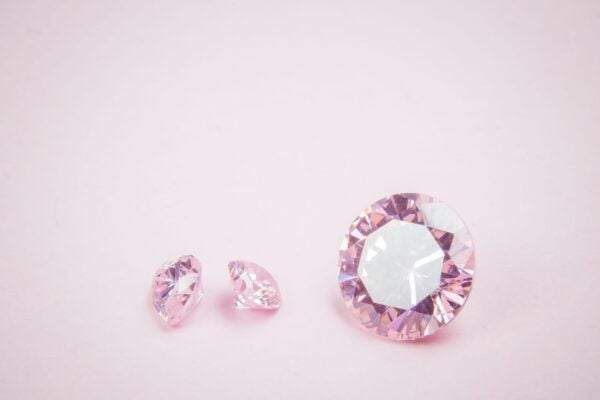
When it comes to a diamond's colour, many people think that a "good" colour means that it is brilliantly white - but this is seldom the case. Nature has provided a whole spectrum of colours in the makeup of diamonds, including red, pink, green, blue, and yellow. Acting as a prism, a diamond divides light into a spectrum of colours and reflects this light as colourful flashes called fire. The less colour in a diamond means the more colourful the fire , which results in a better colour grade.

|
^Top
CUT
Many gemologists consider the cut of a diamond to be its most important characteristic. The cut determines how light is reflected within the diamond and how brilliant it will be. In other words, a diamond with a poor cut will appear dull, even if it has the perfect colour and clarity.
The first important factor of a diamond's cut is the width and depth. If a diamond is too deep, light escapes out the sides, causing the diamond to appear dark and dull.
Another important factor of the diamond's cut is its proportions, which determine how well light will reflect and refract within the diamond. The proportions are measured by the depth compared to the diameter, and the diameter of the table compared to the diameter of the diamond.

| The Grading of a Diamond's Cut |
| Ideal Cut : |
A symmetrically superior quality diamond. Representative of the top 3% of diamond quality. Reflects all light that enters the diamond. |
| Very Good: |
A exquisite quality diamond. Representative of the top 10% of diamond quality. Reflects nearly all light that enters the diamond. |
| Good: |
A quality diamond. Represents roughly the top 25% of diamond quality. Reflects most light that enters, less expensive than a very good cut. |
| Fair: |
Still considered a quality diamond. Represents roughly the top 35% of diamond quality. A fair cut will not be as brilliant as a good cut. |
| Poor: |
All diamonds below the standards of a fair cut. The cut is deep and narrow or shallow and wide, resulting in a dull appearance. |
^Top
CARAT WEIGHT
This is the size of the diamond measured in carats. One carat is divided into 100 "points" so that a diamond of 75 points weighs .75 carats. Carat weight is the most obvious factor in determining the value of a diamond. But two diamonds of equal carat weights can have very unequal prices, depending on their quality, and diamonds of high quality can be found in all size ranges.
Larger diamonds are rarer and in more demand than smaller stones of the same quality, so they can be sold for a higher price. A one carat diamond solitaire ring will nearly always be more expensive than a diamond ring made up of similar, but smaller, diamonds totaling one carat (or more).

^Top
CERTIFICATION
The diamond report an essential statement attesting to the authenticity of a diamond and providing a reliable and accurate statement of its identity and grade based on an internationally recognized system.
The procedures used by IGL to grade diamonds are designed to achieve the utmost accuracy. Each diamond is subject to the scrutiny and analysis by a renowned diamond grader and gemologist. The diamond grading report details the IGL's authoritative assessment of a diamond's 4Cs – colour, clarity, cut, and carat weight.
What's more, since IGL is not affiliated with any retailer, wholesaler, or manufacturer, you gain extra peace of mind knowing that your IGL report re pr esents the impartial opinion of unbiased professionals.
^Top
Conflict Free
What YOU need to know about conflict diamonds!
Conflict diamonds are diamonds that originate from areas controlled by forces or factions opposed to legitimate and internationally recognised governments. They are obtained through horrendous abuses of human rights. These diamonds are used to fund military action in opposition to governments, causing countless innocent lives to be destroyed.
To eliminate the traffic in conflict diamonds governments and the international diamond jewellery industry and non-government organisations have developed solutions that provide greater assurances to the consumer about the legitimate origin of the diamond they are purchasing. This system is called the Kimberly Process. To learn more, go to: www.kimberlyprocess.com
http://web.amnesty.org/pages/ec-diamonds-eng
^Top |